Research a YouTube niche by checking four things before you film anything: what people search for, who already wins and how big, what viewers keep asking for, and where the gaps are. On November 21, 2026 we asked Creator Research's niche agent to do this for faceless history documentaries. It ran three YouTube searches and three lookups of what people type into YouTube (79 phrases), read 30 top comments, and answered in 46.5 seconds for 2 credits.
Here is what it found, which numbers we checked, and how to run it on your own niche.
What did the research do, step by step?
We asked one question: research the faceless history documentary niche on YouTube, what people search for, which channels and videos win, what the audience asks for, and the gaps a new channel could fill.
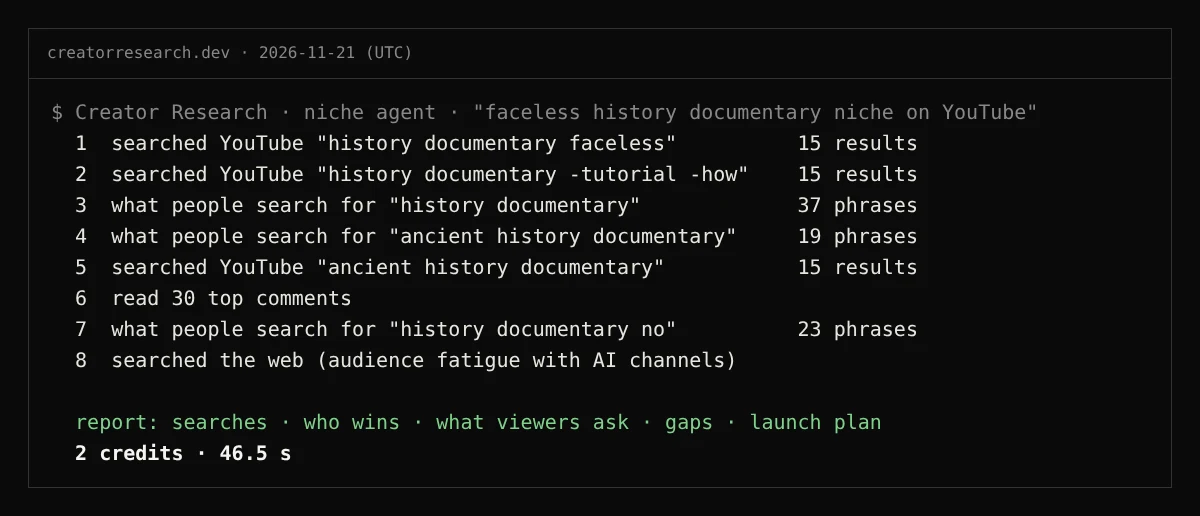 The real run, November 21, 2026 (UTC).
| What it did | Result |
|---|---|
| Searched YouTube | 3 searches, 15 results each |
| Looked up what people type into YouTube | 3 lookups, 79 phrases (37, 19 and 23) |
| Read comments | 30 top comments on a leading video |
| Searched the web | 1 search |
| Time | 46.5 seconds |
| Credits | 2 |
How we measured: time and credits are from the answer's own response (started 22:34:00 UTC); the steps are the list the agent returns with every answer.
What are people actually searching for in this niche?
This comes from YouTube's own search suggestions, the phrases real viewers type. Three patterns stood out:
- "No AI." Viewers add "no ai", "not ai" and "not ai generated" to "history documentary". They are filtering out machine-voiced slideshows.
- "For sleep." "history documentary sleep" and "history documentary to sleep to" are common: people play long history videos as background.
- Ancient first. "ancient history documentary" and "bronze age collapse" lead, ahead of later periods.
Search suggestions show what people type, not how many people type it. If you need monthly volumes, check them separately.
Who already wins, and how big is "big"?
The report named Fall of Civilizations as the model for the niche: films of two to three hours, a calm human narrator, original footage of the places. We checked its numbers ourselves (5 credits for the channel's 45 videos):
| Video | Views | Length |
|---|---|---|
| The Sumerians - Fall of the First Cities | 41,204,559 | 147 min |
| The Assyrians - Empire of Iron | 22,292,022 | 185 min |
| The channel's typical (median) video | 3,273,133 | - |
The report's figures for both films, 41 million and over 22 million, matched. The lesson for a new channel is not "make 3-hour films": it is that in this niche viewers reward depth and a real voice, which an 8-minute generated slideshow can't give.
What does the audience keep asking for?
From the 30 top comments the agent read on The Sumerians, as it quoted them:
- Real history, not sensationalism. The most-liked comment thanks the channel for a documentary about the Sumerians "that isn't talking about aliens".
- No host in the way. Another praises a documentary with "actual information, as opposed to the host's massive ego taking center stage", a good sign for a faceless format.
- Their own history told well. Viewers from Iraq, Syria and Egypt thank the channel for covering culture, law and poetry, not only wars.
Where are the gaps a new channel could fill?
The report's suggestions, which follow from the searches and comments above:
- Make "human-researched, human-narrated" visible, with sources in the description, since viewers search for "no ai".
- Cover civilizations the big channels haven't: it named Elam, Akkad, the Etruscans, the Moche, Tiwanaku and the Indus Valley.
- Publish quiet "for sleep" versions of long episodes, matching the sleep searches.
- Start with 25 to 40 minute episodes before attempting two-hour films.
These are ideas to test against the outliers of channels in the niche, not proven formats. Our guide to finding outlier videos shows how.
What should I check myself before trusting a niche report?
- The view counts that decide your choice. We checked the two biggest; both held. We left out figures we didn't check.
- Volume. Suggestions show what people search, not how often.
- Your own fit. Whether you can make two-hour documentaries, or want to, is a question no report answers.
How do I run this on my own niche?
- Open Creator Research and choose Research niche.
- Type the niche in a few words ("home espresso", "faceless history documentaries", "budget travel Japan").
- Ask the follow-ups it offers: the easiest keywords, 10 video ideas, the rising creators.
A question costs 1 to 5 credits. Creator Research is included in every plan from $5 a month, or with any credit pack (pricing).
Frequently asked questions
How do I know if a YouTube niche is worth starting?+
Check four things: people search for it (YouTube's own search suggestions show the phrases), channels in it get views, viewers ask for things nobody is making, and you can make those videos well. A niche agent can gather the first three in under a minute; the fourth is up to you.
Is there a free YouTube niche finder?+
Creator Research is included in every plan from $5 a month, or with any credit pack, and our niche run cost 2 credits. It reads YouTube's search suggestions, the top videos and their comments, and answers with sources. It does not give monthly search volumes.
What did the niche research find for faceless history channels?+
That viewers add "no ai" and "for sleep" to their searches, that long, carefully researched films win (Fall of Civilizations' The Sumerians has 41.2 million views), and that top comments thank channels for avoiding sensationalism.
Can I trust an AI niche report?+
Use it as a map, then check the numbers that decide your choice. We checked the two biggest view counts in our report and both matched YouTube within the same day.